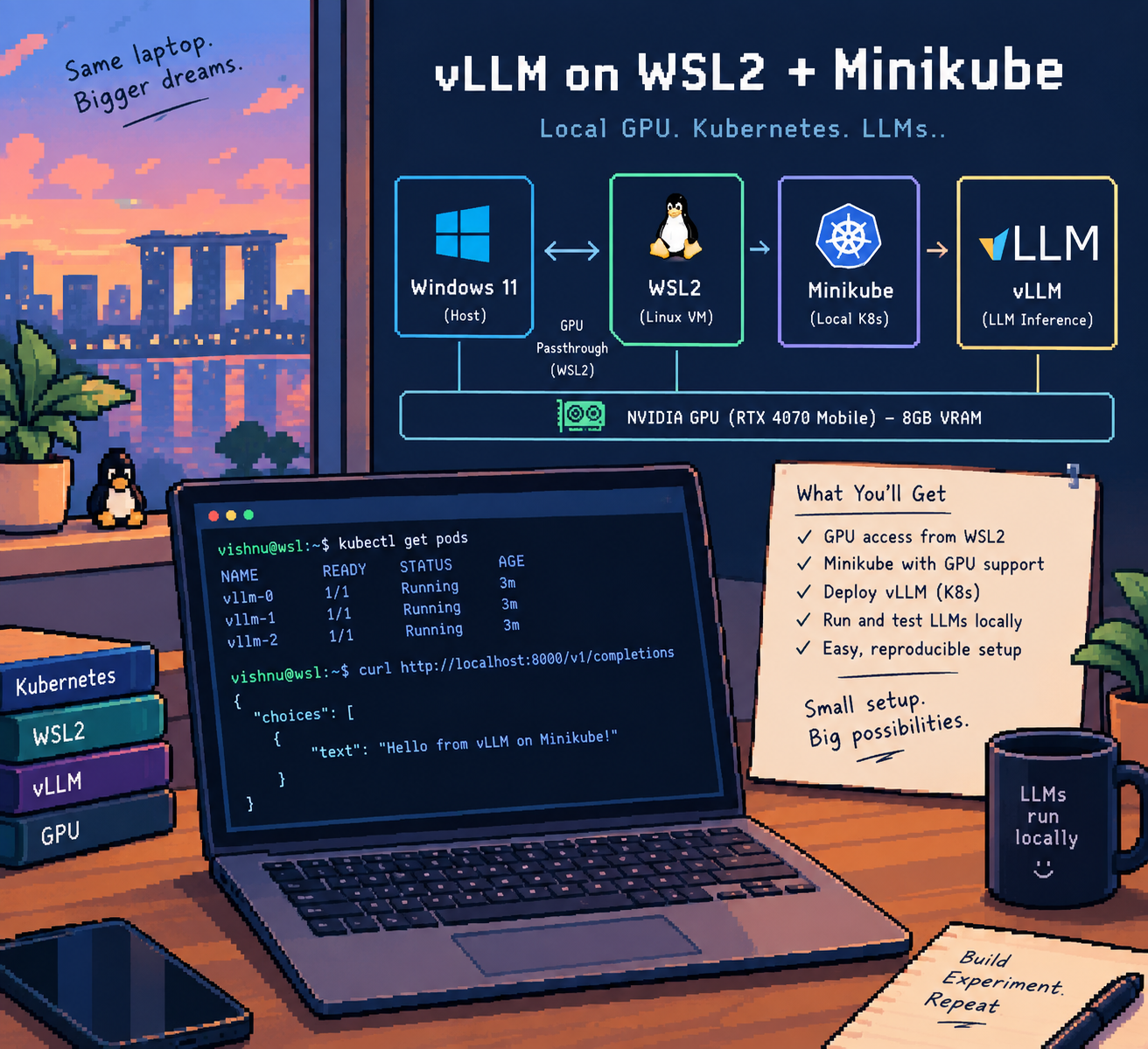
Run vLLM on Kubernetes with Minikube, WSL2 and NVIDIA GPU

This is the vLLM entry in my local AI series. After testing Ollama, llama.cpp, and FreeToken, I wanted to run vLLM as a Kubernetes Deployment on my Windows/WSL2 setup. The plan was simple: deploy vLLM, request nvidia.com/gpu: 1, expose an OpenAI-compatible API endpoint through a Service, and tie it into the Kubernetes workflows I write about regularly. Getting a GPU into Kubernetes on WSL2 turned into an investigation. Not because vLLM is hard, but because container runtimes and nested clusters handle GPU passthrough in non-obvious ways. Here is what happened, how the device plugin and node prerequisites work, and how to get a working GPU cluster running with Minikube. ...

September 8, 2026 · 13 min · 2557 words

Running a 35B MoE Model on an 8 GB Laptop GPU: Testing FreeToken

Running large language models locally usually comes down to a hard hardware boundary: video RAM. If a model does not fit into your GPU’s VRAM, performance usually falls off a cliff as soon as standard runtimes fall back to system memory over the PCIe bus. Mixture of Experts (MoE) architectures offer an attractive theoretical escape hatch. While the total parameter count can be large (30B to 70B+), only a sparse subset of expert layers activates for any given token. However, standard local runtimes still require loading the entire weight footprint into memory, which puts 30B+ models out of reach for everyday consumer laptops with 8 GB of VRAM. ...

September 7, 2026 · 7 min · 1316 words