Pixel art of three llama portraits rendered at progressively coarser precision beside a compact GPU

LLM Quantization, Simply: FP16, 8-bit, 4-bit, and What Q4_K_M Means

A simple, diagram-first guide to LLM quantization: what rounding a weight actually does, how much memory each bit width saves, how to read names like Q4_K_M, AWQ, and FP8, and a toy script that shows where quality falls off.


Pixel art comparison showing a glowing branching Radix tree with structured bracket gates on the left and a GPU processor core packing memory pages into parallel token streams on the right

SGLang vs. vLLM: RadixAttention, Structured Outputs, and When to Pick Which

A simple, diagram-first comparison of SGLang and vLLM: how RadixAttention works, how jump-forward decoding speeds up JSON outputs, how their schedulers compare, and which engine fits your workload.

Pixel art laptop projecting a holographic GPU cluster of amber wireframe cards, with a router tower sending request cubes to them and the brightest path going to the card that holds matching cache cubes

No GPU? Simulate One: vLLM, llm-d, and 16 Fake H100s on a Laptop

A hands-on lab for learning GPU scheduling and LLM routing without a GPU: kind, fake-gpu-operator, llm-d-inference-sim, and the llm-d router, with real screenshots and benchmark numbers.

Pixel art router tower sending glowing requests to GPU racks, with the brightest path going to the rack that already holds matching cache cubes

llm-d, Simply: A Smarter Router for vLLM on Kubernetes

A practical, diagram-first guide to llm-d: why round-robin wastes GPUs, how cache-aware routing works, which well-lit path to start with, and the commands to deploy it.

Pixel art cache vault reusing stored memory blocks across three GPU servers

Why LMCache Exists: Stop Making GPUs Read the Same Context Again

An example-driven guide to LMCache: repeated prefill, KV cache reuse, CPU offloading, multi-replica serving, and where caching actually helps.

Pixel art GPU server packing memory pages and serving many parallel token streams

Why vLLM Is Dominating the AI Inference Market

How PagedAttention, continuous batching, hardware portability, and an open ecosystem made vLLM the default engine for high-throughput LLM serving.

Pixel art showing a question becoming tokens, passing through a neural-network chip, and emerging as an answer

What Happens When You Ask an LLM a Question

My visual notes on how LLMs work: tokens, parameters, attention, reasoning, KV cache, quantization, and serving models on GPUs.

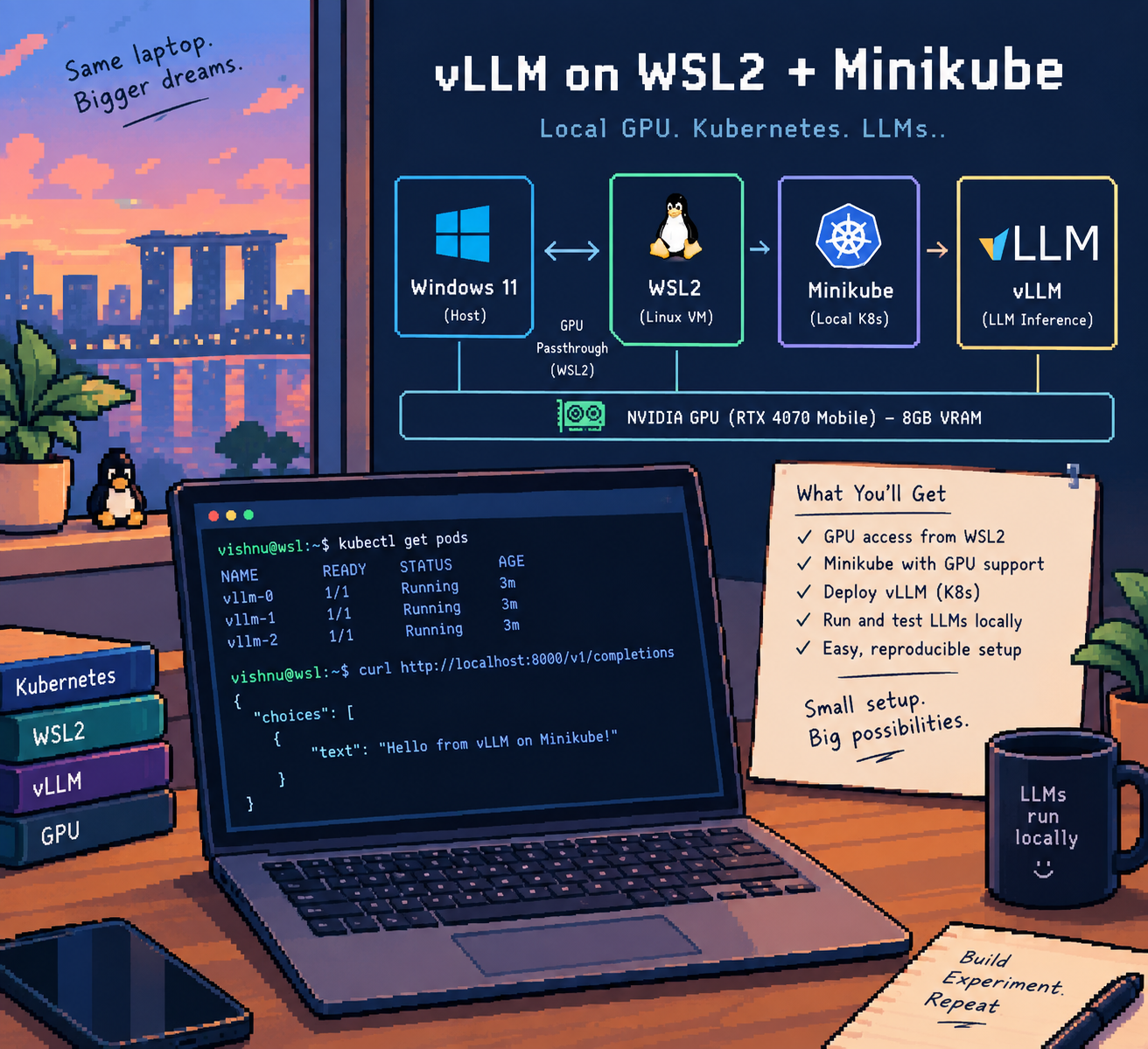
Run vLLM on Kubernetes with Minikube, WSL2 and NVIDIA GPU

Run vLLM on Kubernetes with Minikube, WSL2 and NVIDIA GPU

A practical guide to running vLLM on Kubernetes in WSL2 with Minikube, configuring NVIDIA GPU passthrough, and serving an OpenAI-compatible API.